Ten places, one map, and how far apart they really are. Every distance below is measured on foot from Jemaa el-Fna — the square everyone starts from.
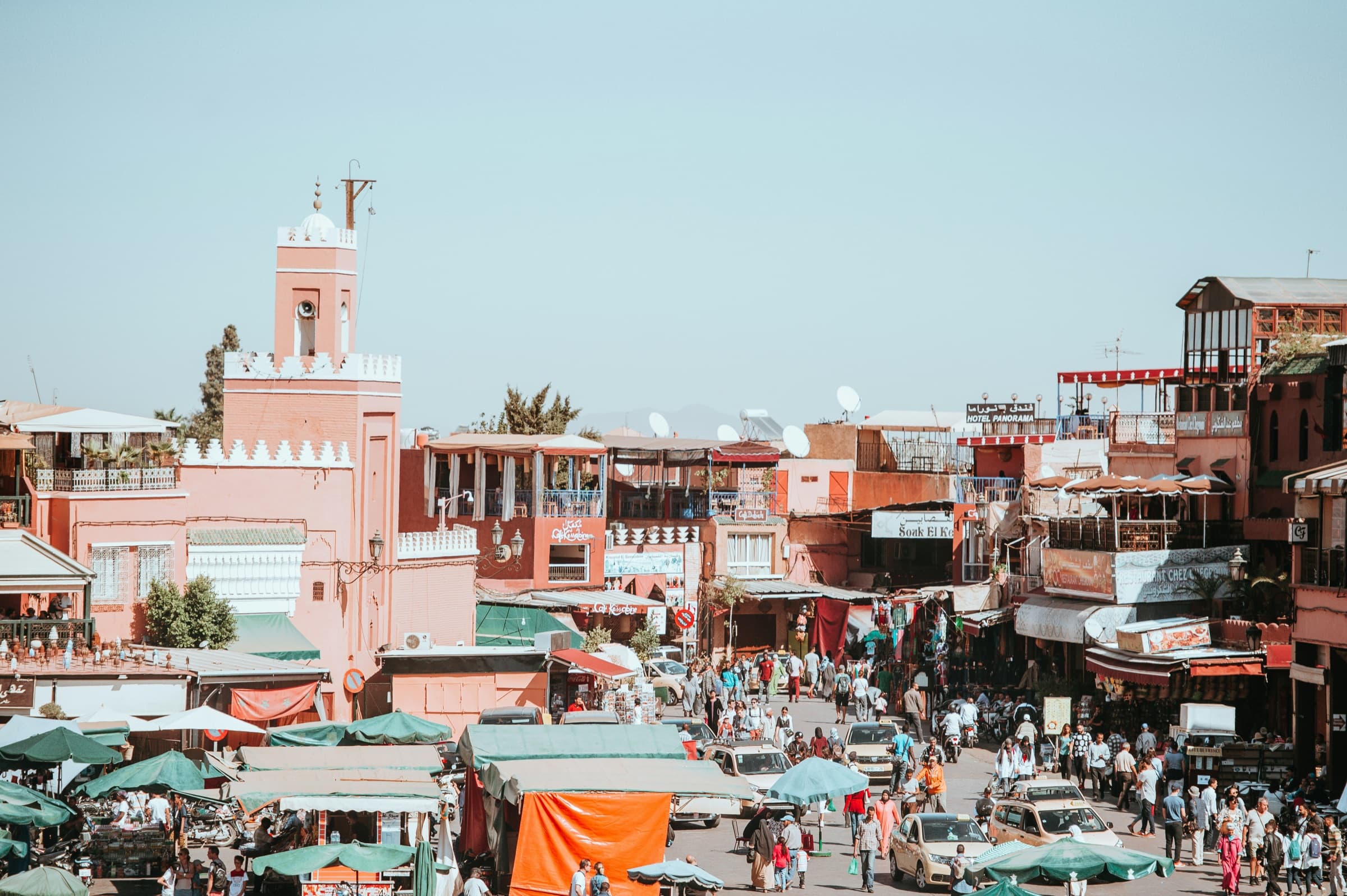
The open square at the heart of the medina, and the point every distance here is measured from. Quiet and ordinary by day; from about six in the evening the food stalls go up in under an hour and it becomes the reason people come to Marrakech. Go at dusk, at least once.
Its 77-metre minaret is the tallest thing in the old city and the landmark you navigate by — lost in the souks, walk towards it. The mosque is closed to non-Muslims, but the gardens beside it are open, free, and at their best in the last hour of daylight.
The covered lanes running north from the square. Go between ten and noon, when the light comes through the slatted roofs and before the afternoon crowds. The price you are quoted is an opening offer, not a price — expect to settle well below the first number, and walk away when it stops being fun.
A rooftop on Rahba Kedima, the spice square, and the easiest place in the medina to stop without being sold anything. Three floors up, mint tea, and a view over the baskets and herbalists' stalls below. Keep it for the moment the souks start to wear you down.
A restored riad garden in the middle of the Mouassine quarter, and the easiest place to sit down when the medina becomes too much. Small, calm, and its tower is one of the few rooftops open to the public.
The pasha of Marrakech's palace from the 1910s, restored and reopened as the Museum of Confluences — courtyards, zellij, and one very large fountain. Bacha Coffee occupies a wing of it: a colonial-style coffee room with a few hundred single-origin coffees and prices to match. Worth the visit for the building alone.
A 16th-century Quranic school with the finest zellij tilework in the city. It reopened after a long restoration, and the courtyard is the photograph everyone wants — all the more reason to be there when the doors open rather than at midday.
A 19th-century palace built for a grand vizier, remembered for its painted cedar ceilings — a different pattern in every room. It is on every tour itinerary, so come early or in the last two hours of the afternoon. El Badi Palace, ruined and roofless, is ten minutes further south and makes a good pair.
A royal burial ground from the 1590s, walled up for three centuries and only rediscovered in 1917. The visit itself is short — the queue is often longer than the tombs — so combine it with El Badi and the Kasbah mosque next door.
The cobalt-blue villa and cactus garden that Yves Saint Laurent bought and saved, with his museum next door. It is in Gueliz, outside the medina walls, so this is the one you take a taxi to. Book a time slot online before you go — it sells out most days.
Not everything worth seeing is inside the walls. Drive times are from central Marrakech, one way.
Stone desert and dunes, without the flight to the Sahara. Best at sunset.
River, waterfalls and Berber villages in the Atlas foothills.
A 110-metre waterfall, and wild macaques in the olive trees.
Atlantic port town — wind, ramparts and grilled fish on the quay.
The fortified earthen village beyond the Atlas pass. UNESCO listed.
We run fixed-price transfers from Menara Airport to any riad in the medina, and we drive every trip on this page. No meter, no haggling, and the driver waits if your flight is late.
Book a transferCurrency, SIM cards, tipping, what to wear and the scams worth knowing about are all in our first-timer's guide.
Read: first time in Marrakech →