
The Morocco Sahara desert, from Marrakech
The dunes are a long way from Marrakech — further than most tours admit. This is which desert to choose, how many days it honestly takes, when to go, and what it costs.
- Marrakech → Merzouga560 km
- Driving time8–10 h
- Days needed3
- Best monthsMar–May · Sep–Nov
The decision nobody explains properly
Almost every “Sahara desert tour from Marrakech” is one of three trips, and they are not remotely the same. The difference between them is the difference between the desert you imagined and a disappointing afternoon at some low dunes beside a road.
Erg Chebbi (Merzouga)
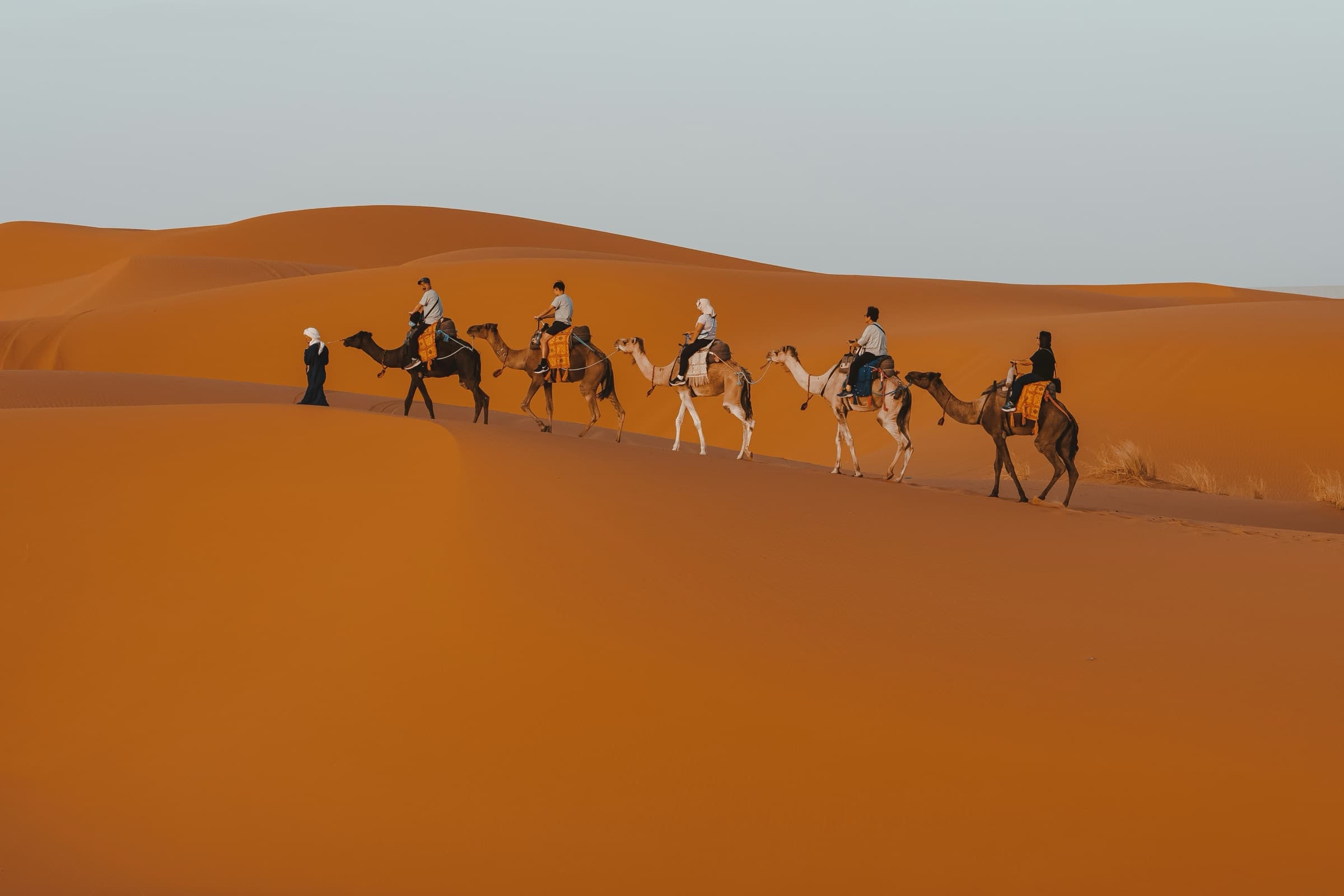
The Sahara most people picture. Tall, sculpted dunes running for 22 km, camps at the edge reached by camel, and the classic sunrise. Getting there crosses the Atlas at Tizi n’Tichka, Aït Ben Haddou, Ouarzazate and the Todra or Dades gorges — the drive is genuinely part of the trip.
Erg Chigaga (M’Hamid)
Bigger, emptier and much less visited. The last 60 km is off-road and needs a 4x4, which is exactly why far fewer people go. Choose it if solitude matters more to you than the tallest dunes.
Zagora (Tinfou)
What almost every cheap “2-day desert tour” actually sells. The dunes are small and close to the road. It is a long way to drive for something that does not look like the photographs you booked it for — but it is the only real option if two days is genuinely all you have.
How many days you actually need
- Two days. Zagora only. Roughly twelve hours in a vehicle for one night beside small dunes. Do it if two days is all you have — but know what you are buying.
- Three days. Merzouga and Erg Chebbi, the trip worth taking. Day one crosses the Atlas and stops at Aït Ben Haddou and Ouarzazate; day two runs through the Dades or Todra gorges to the dunes for sunset, camel trek and the camp; day three returns.
- Four days or more. The same route without the rushing, or Erg Chigaga, or continuing north to Fes instead of doubling back — which turns the drive home into a second journey rather than a repeat of the first.
When to go
March to May and September to November are the good months: warm days, cool nights, bearable dunes. June to August pushes past 45 °C and a desert camp in that heat is endurance, not pleasure. December to February gives beautiful clear days around 18–20 °C, but the nights fall close to freezing — camps supply heavy blankets and you will want them.
What a night in the camp is like
You leave the vehicle at the edge of the erg in the late afternoon and cover the last stretch by camel, roughly an hour, arriving as the light goes. Camps sit in a hollow between dunes: a ring of tents, a fire, dinner — usually tagine — and drumming afterwards. Standard camps share washing facilities; luxury camps have private tents with proper bathrooms. It gets cold and it gets extremely dark, which is the point: the sky is the reason to stay. Most people climb a dune for sunrise and are back on the road by nine.
Private or shared?
A shared group tour is genuinely cheaper if you are travelling alone, and there is no shame in taking one. What you give up is the schedule, the stops, and who you spend three days in a minibus with — you leave when the group leaves and you photograph what the group photographs.
We price per vehicle rather than per person, covering the driver, the fuel and pickup from your hotel or riad. Three or four people travelling together therefore pay the same as one, which is where a private trip usually stops costing more than a shared seat. Tell us your dates and how many of you there are and we will confirm the price within minutes.
See all day trips and multi-day routes →
Go deeper
Four companion guides cover the decisions this page can only summarise — which desert, how long, when, and what the night in the camp is actually like.
- Merzouga or Zagora? — the comparison in full, including Erg Chigaga.
- How many days do you need? — what two, three, four and five days each reach.
- A night in a desert camp — the camel, the cold, the food, and standard versus luxury.
- Best time to visit — month by month, and how to survive going in summer.
Questions people ask
How far is the Sahara desert from Marrakech?
Merzouga and the Erg Chebbi dunes are about 560 km from Marrakech — eight to ten hours of driving over the Tizi n’Tichka pass. Zagora is closer at roughly 360 km and six to seven hours, but the dunes there are small.
Is a 2-day desert trip from Marrakech worth it?
A two-day trip can only reach Zagora, where the dunes are low and thin. You spend roughly twelve hours in the car for one night. If the towering dunes are what you came for, you need three days and Merzouga.
What is the difference between Erg Chebbi and Erg Chigaga?
Erg Chebbi, near Merzouga, has the tallest dunes — up to about 150 metres — and camps you can reach by road and then camel. Erg Chigaga, near M’Hamid, is larger and far more remote, but the last stretch needs a 4x4 and there are fewer camps.
When is the best time to visit the Moroccan Sahara?
March to May and September to November. Summer daytime temperatures pass 45 °C and the camps are punishing. Winter days are pleasant at around 18–20 °C, but desert nights drop close to freezing.
How much does a Sahara desert trip from Marrakech cost?
Our trips are priced per vehicle rather than per person, covering the driver, the fuel and pickup from your hotel or riad — so three or four people travelling together pay the same as one. Send us your dates and group size and we confirm the price within minutes.
Do you sleep in a tent in the Sahara?
Yes, in a desert camp. Standard camps have shared facilities and simple beds; luxury camps have private tents with proper bathrooms. Both serve dinner under the stars, and both are reached by camel or 4x4 from the edge of the dunes.
Go to the Sahara with your own driver
Three days to Merzouga, private vehicle, your own schedule — stop where you want, leave when you want, and sleep in the dunes rather than beside a road. Fixed price, agreed before you go.
Book your Sahara trip